Vegetos

(An International Journal of Plant Research & Biotechnology)
(eISSN: 2229-4473)
Nutritional and mineral profiling of Myrica esculenta Buch. -Ham. ex D. Don: an economically important wild fruit from the Himalayas
*Article not assigned to an issue yet
Research Articles | Published: 19 May, 2026
First Page: 0
Last Page: 0
Views: 65
Keywords: n Myrica esculentan , Nutrient profiling, Mineral analysis, Genotype selection, Himalaya
Abstract
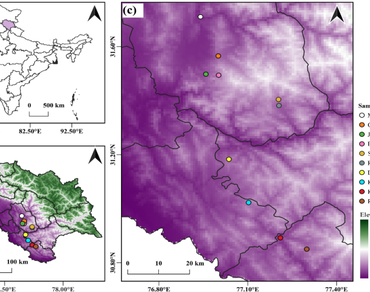
Myrica esculenta is an economically important wild edible plant native to the Indian Himalaya. The present study aimed to evaluate the nutritional quality and identify superior genotypes among ten geographically distinct populations of M. esculenta from Himachal Pradesh. Morphological traits, proximate composition, and mineral content of fruits were analyzed over two consecutive years (2018–2019). Among the studied populations, the Rajgarh population exhibited significantly higher fruit weight (2018: 0.78 ± 0.03 g; 2019: 1.01 ± 0.01 g), moisture content (2018: 72.30 ± 1.92%; 2019: 62.47 ± 0.98%), soluble protein (2018: 4.19 ± 0.06%; 2019: 4.87 ± 0.08%), and ascorbic acid content (2018: 0.42 ± 0.02%; 2019: 0.35 ± 0.03%) compared to other populations, indicating its potential suitability for selective cultivation. Across all populations, fruits were found to be rich in carbohydrates (2018: 88.50 ± 0.92%; 2019: 85.04 ± 0.76%), energy content (2018: 382.22 ± 2.27%; 2019: 398.68 ± 3.35%), and essential minerals, including Ca, Cu, Fe, Mg, K, and Zn. Morphological and mineral analyses revealed both significant (p < 0.05) and non-significant (p > 0.05) variations among populations, whereas proximate composition showed predominantly non-significant variation. Overall, the results suggest that targeted propagation of nutritionally superior genotypes could enhance nutritional security and increase the chemical potential of M. esculenta in the Himalayan region.
References
Acosta-Montoya O, Vaillant F, Cozzano S, Mertz C, Pérez AM, Castro MV (2010) Phenolic content and antioxidant capacity of tropical highland blackberry (Rubus adenotrichus Schltdl.) during three edible maturity stages. Food Chem 119:1497–1501. https://doi.org/10.1016/j.foodchem.2009.09.032
Anjum N, Tripathi YC (2021) Evaluation of total polyphenols, flavonoids and antioxidant activity of M. esculenta Buch. Ham. ex. D. Don fruits. World J pharm med 7:186–192. https://doi.org/10.17605/OSF.IO/H4FYZ
Bhatt DI, Ranbeer S, Rawal U (2000) The availability fruit yield, and harvest of Myrica esculenta in Kumaun (West Himalaya), India. Mt Res Dev 20:146–153. https://doi.org/10.1659/0276-4741(2000)020[0146:TAFYAH]2.0.CO;2
Bhatt ID, Rawat S, Rawal RS (2020) Himalayan bayberries. In nutritional composition and antioxidant properties of fruits and vegetables. Academic Press, 457–465
Bisht IS, Mehta PS, Negi KS, Rawat R, Singh R, Garkot S (2017) Wild plant food resources in agricultural systems of Uttarakhand Hills in India and its potential role in combating malnutrition and enhancing human health. J Food Sci Toxicol 2:3
Boussaida M, Taïbi K, Ait Abderrahim L, Ennajah A (2018) Genetic diversity of Ziziphus lotus natural populations from Algeria based on fruit morphological markers. Arid Land Res Manag 32:184–197. https://doi.org/10.1080/15324982.2018.1424742
De Smet (1997) The role of plant-derived drugs and herbal medicines in healthcare. Drugs 54:801–840. https://doi.org/10.2165/00003495-199754060-00003
Dhani A (2013) Major wild edible fruits used by locals of Garhwal Himalaya. Int J Adv Life Sci 6:145–149
Diaz-Garcia L, Covarrubias-Pazaran G, Schlautman B, Grygleski E, Zalapa J (2018) Image-based phenotyping for identification of QTL determining fruit shape and size in American cranberry (Vaccinium macrocarpon L). J Environ Sci 6:1–19. https://doi.org/10.7717/peerj.5461
Dorais M, Ehret DL, Papadopoulos AP (2008) Tomato (Solanum lycopersicum) health components: from the seed to the consumer. Phytochem Rev 7:231–250. https://doi.org/10.1007/s11101-007-9085-x
Gecer MK, Kan T, Gundogdu M, Ercisli S, Ilhan G, Sagbas HI (2020) Physicochemical characteristics of wild and cultivated apricots (Prunus armeniaca L.) from Aras valley in Turkey. Genet Resour Crop Evol 67:935–945. https://doi.org/10.1007/s10722-020-00893-9
Goutam KR, Kunwar RM, Bussmann RW, Paniagua-Zambrana NY (2020) Myrica esculenta Buch.-Ham. Don Myricaceae Ethnobotany 3:1–8. https://doi.org/10.1007/978-3-030-45597-2_157-1. Ex D.
Heinrich M, Nebel S, Leonti M, Rivera D, Obón C (2006) Local food nutraceuticals: Bridging the gap between local knowledge and global needs. Forum Nutr 59:1–17. https://doi.org/10.1159/000195205
Huguet V, Gouy M, Normand P, Zimpfer JF, Fernandez MP (2005) Molecular phylogeny of Myricaceae: a reexamination of host–symbiont specificity. Mol Phylogenet Evol 34:557–568. https://doi.org/10.1016/j.ympev.2004.11.018
Jeeva S, Lyndem FB, Sawian JT, Laloo RC, Mishra BP (2011) Myrica esculenta Buch.-Ham. ex D. Don.- a potential ethnomedicinal species in a subtropical forest of Meghalaya, northeast India. Asian Pac J Trop Biomed 1:174–177. https://doi.org/10.1016/S2221-1691(11)60150-0
Kabra A, Baghel US (2018) Nutritional value and elemental analysis of Katphala (Myrica esculenta Buch-Ham). J Biol Chem Chron 4:19–25
Kabra A, Martins N, Sharma R, Kabra R, Baghel US (2019) Myrica esculenta Buch. -ham. Ex D. Don: a natural source for health promotion and disease prevention. Plants 8:1–21. https://doi.org/10.3390/plants8060149
Khanduri VP, Sukumaran A, Sharma CM (2019) Male-skewed sex ratio in Myrica esculenta: a dioecious tree species. Trees 33:1157–1165. https://doi.org/10.1007/s00468-019-01850-5
Kim EH, Lee SY, Baek DY, Park SY, Lee SG, Ryu TH, Lee SK, Kang HJ, Kwon OH et al (2019) A comparison of the nutrient composition and statistical profile in red pepper fruits (Capsicums annuum L.) based on genetic and environmental factors. Appl Biol Chem 62:1–3. https://doi.org/10.1186/s13765-019-0456-y
Krishnamurthy SR, Sarala P (2012) Determination of nutritive value of Ziziphus rugosa Lamk a famine edible fruit and medicinal plants of Western Ghats. Indian J Nat Prod Resour 3:20–27. http://nopr.niscpr.res.in/handle/123456789/13801
Kumar T, Pande KK, Mathur A, Karanga M, Pande B (2021) Study of antimicrobial and antimicrobial and antioxidant activities of solvent extracts of fruits of Myrica esculenta. Plant Arch 21:987–991. https://doi.org/10.51470/PLANTARCHIVES.2021.v21.S1.154
Lowry OH, Rosebrough NJ, Farr AL, Randall RJ (1951) Protein measurement with the Folin phenol reagent. J Biol Chem 193:265–275
Lutzow-Felling CJ, Gardner DE, Markin GP, Smith CW (1995) Myrica faya: review of the biology, ecology, distribution, and control, including an annotated bibliography, 956–8218
Mann S, Satpathy G, Gupta RK (2015) In vitro evaluation of bio-protective properties of underutilized Myrica esculenta Buch. –Ham. ex D. Don fruit of Meghalaya. J Nat Prod Resour 6:183–188. http://nopr.niscpr.res.in/handle/123456789/32671
Mkwezalamba I, Munthali CR, Missanjo E (2015) Phenotypic variation in fruit morphology among provenances of Sclerocarya birrea (A. Rich.) Hochst. Int J Res 9:1–9. https://doi.org/10.1155/2015/735418
Muthai KU, Karori MS, Muchugi A, Indieka AS, Dembele C, Mng’omba S, Jamnadass R (2017) Nutritional variation in baobab (Adansonia digitata L.) fruit pulp and seeds based on Africa geographical regions. Food Sci Nutr 5:1116–1129. https://doi.org/10.1002/fsn3.502
Nestby R, Hykkerud AL, Martinussen I (2019) Review of botanical characterization, growth preferences, climatic adaptation and human health effects of Ericaceae and Empetraceae wild dwarf shrub berries in boreal, alpine and arctic areas. J Berry Res 9:515–547. https://doi.org/10.3233/JBR-190390
Pant G, Prakash O, Chandra M, Sethi S, Punetha H, Dixit S, Pant AK (2014) Biochemical analysis, pharmacological activity, antifungal activity and mineral analysis in methanolic extracts of Myrica esculenta and Syzygium cumini: the Indian traditional fruits growing in Uttarakhand Himalaya. Indian J Pharm Biol Res 2:26–34
Patel KG, Rao NJ, Gajera VG, Bhatt PA, Patel KV, Gandhi TR (2010) Antiallergic activity of stem bark of Myrica esculenta Buch.-Ham.(Myricaceae). J Young Pharm 2:74–78. https://doi.org/10.4103/0975-1483.62219
Rawat JM, Tomar YK, Rawat V (2009) Effect of pretreatments on Myrica esculenta D. don (Kaphal) seed germination and seedling performance. Trees Livelihoods 19:193–197. https://doi.org/10.1080/14728028.2009.9752664
Roe J, Kuether C (1943) Estimation of ascorbic acid. J Biol Chem 147:3999–4013. https://doi.org/10.1021/ac50121a012
Ruiz-Rodríguez BM, Morales P, Fernández-Ruiz V, Sánchez-Mata MC, Camara M, Díez-Marqués C, Pardo-de-Santayana M, Molina M, Tardío J (2011) Valorization of wild strawberry-tree fruits (Arbutus unedo L.) through nutritional assessment and natural production data. Food Res Int 44:1244–1253. https://doi.org/10.1016/j.foodres.2010.11.015
Rymbai H, Roy AR, Deshmukh NA, Jha AK, Shimray W, War GF, Ngachan SV (2016) Analysis study on potential underutilized edible fruit genetic resources of the foothills track of Eastern Himalayas, India. Genet Resour Crop Evol 63:125–139. https://doi.org/10.1007/s10722-015-0342-3
Rymbai H, Verma VK, Talang H, Assumi SR, Devi MB, Vanlalruati, Sangma RH, Biam KP, Chanu LJ, Makdoh B, Singh AR, Mawlein J, Hazarika S, Mishra VK (2023) Biochemical and antioxidant activity of wild edible fruits of the eastern Himalaya, India. Front Nutr 10:1039965. https://doi.org/10.3389/fnut.2023.1039965
Saklani SA, Chandra SU, Mishra AP, Badoni PP (2012) Nutritional evaluation, antimicrobial activity and phytochemical screening of wild edible fruit of Myrica nagi pulp. J Pharm Pharm Sci 4:407–411
Seal T (2011) Nutritional composition of wild edible fruits in Meghalaya state of India and their ethno-botanical importance. Res J Bot 6:58–67. https://doi.org/10.3923/rjb.2011.58.67
Seal T, Pillai B, Chaudhuri K (2014) Nutritional potential of wild edible fruits, traditionally used by the local people of Meghalaya state in India. Indian J Nat Prod Resour 5:359–364. http://nopr.niscpr.res.in/handle/123456789/30551
Silva BJ, Seca AM, Barreto MD, Pinto DC (2015) Recent breakthroughs in the antioxidant and anti-inflammatory effects of Morella and Myrica species. Int J Mol Sci 16:17160–17180. https://doi.org/10.3390/ijms160817160
Singh R, Rawat M, Chand T, Tripathi SK, Pandey R (2023) Phenological variations in relation to climatic variables of moist temperate forest tree species of western Himalaya. India Heliyon 9:e16563. https://doi.org/10.1016/j.heliyon.2023.e16563
Sood P, Shri R (2018) A review on ethnomedicinal, phytochemical and pharmacological aspects of Myrica esculenta. Int J Pharm Sci 80:02–13
Sotelo Montes C, Weber JC (2009) Genetic variation in wood density and correlations with tree growth in Prosopis africana from Burkina Faso and Niger. Ann Sci 66:1–13. https://doi.org/10.1051/forest/2009060
Stewart AL, Ahmed S (2020) Effects of climate change on fruit nutrition. Fruit crops 1:77–93. https://doi.org/10.1016/B978-0-12-818732-6.00007-1
Unuofin JO, Otunola GA, Afolayan AJ (2017) Nutritional evaluation of Kedrostis africana L. Cogn, an edible wild plant of South Africa. Asian Pac J Trop Biomed 7:443–459. https://doi.org/10.1016/j.apjtb.2017.01.016
Vermani A, Navneet P, Chauhan A (2010) Physico-chemical analysis of ash of some medicinal plants growing in Uttarakhand, India. Nat Sci 8:88–91
Yanthan M, Misra AK (2013) Molecular approach to the classification of medicinally important actinorhizal genus Myrica. Indian J Biotechnol 133–136. http://nopr.niscpr.res.in/handle/123456789/16533
Yilmaz KU, Zengin Y, Ercisli S, Demirtas MN, Kan T, Nazli AR (2012) Morphological diversity on fruit characteristics among some selected mulberry genotypes from Turkey. J Anim Plant Sci 22:214–214
Yusuf SN, Rahman AM, Zakaria Z, Subbiah VK, Masnan MJ, Wahab Z (2020) Morphological variability identification of harumanis mango (Mangifera indica L.) harvested from different location and tree age. Trop Life Sci Res 31:107–143. https://doi.org/10.21315/tlsr2020.31.2.6
Zhang Q, Zhou BB, LI MJ, Wei QP, Han ZH (2018) Multivariate analysis between meteorological factor and fruit quality of Fuji apple at different locations in China. J Integr Agric 17:1338–1347. https://doi.org/10.1016/S2095-3119(17)61826-4
Author Information
Faculty of Science and Technology, ICFAI University, Baddi, Solan, , India